
How to Tell If Pearls Are Real: 6 At-Home Tests That Actually Work
The fastest way to tell if a pearl is real is to rub two pearls gently against each other: real pearls have a fine, slightly gritty texture because their surface is built from microscopic layers of nacre, while imitations feel glassy and slide past each other. That single test catches most fakes in a few seconds. Below are six checks you can do at home, in rough order of how reliable they are — plus the one thing none of them can tell you.
First, a definition worth getting right, because it trips up a lot of shoppers.
Cultured freshwater pearls are real pearls
A cultured pearl is a real pearl. It is grown inside a living mollusk, which deposits layer after layer of nacre around a tiny implanted irritant — exactly the same biological process as a wild pearl, just started deliberately by a pearl farmer rather than by chance. Nearly every pearl sold today, at every price point, is cultured; genuinely wild natural pearls are rare enough to belong mostly to auction houses.
What is not real is an imitation pearl: a glass, plastic, or shell bead coated in a pearlescent lacquer. Under US Federal Trade Commission guidelines, those must be described as "imitation," "faux," or "simulated" — the word "pearl" on its own is reserved for the real thing. So when you're testing a strand, you're not asking "natural or cultured?" You're asking "nacre or paint?"
Test 1: The rub test (the most reliable at-home check)
Take two pearls from the same piece and rub them lightly against each other. Real pearls produce a faint sandy resistance and sometimes leave a barely visible dusting of nacre powder. Imitation pearls glide smoothly, like two beads of glass. If you only have one pearl, run it gently along the edge of a fingernail — you're feeling for texture, not scratching.
Test 2: Look at the drill hole
Drill holes are where fakes give themselves away. On a real pearl, the hole edge is crisp and you may see the faint layered structure of nacre, occasionally with a tiny natural chip. On an imitation, the coating tends to flake, bubble, or peel back around the opening, revealing a white or grey bead core underneath. A jeweler's loupe helps, but a phone camera at maximum zoom usually does the job.
Test 3: Check for honest imperfection
Real pearls are never identical. Look across a strand for small variations in shape, tiny surface ridges, faint spots, or subtle differences in tone — the marks of something a mollusk made rather than a machine. A strand of budget pearls that are flawlessly round, spotless, and perfectly matched is usually a sign of manufacturing, not quality. (High-grade round pearls do exist, but they are priced accordingly.) We go deeper into this in our guide to judging pearl quality.
Test 4: Watch how light behaves
Real nacre reflects light with depth, not just brightness. Hold the pearl near a window and you should see a soft glow that seems to come from just beneath the surface, often with a faint pink, green, or silver overtone, and reflections with slightly blurred edges. Imitations reflect light off a single flat plane — the shine sits on top, sharp and mirror-like, or else looks chalky and dead. Once you've seen the difference side by side, it's hard to unsee.

Test 5: Temperature and weight
Real pearls feel cool when you first pick them up, then warm gradually against your skin. Plastic imitations are already at room temperature and warm almost instantly. Weight is a secondary clue: real pearls have a modest heft, while plastic beads feel conspicuously light for their size. Note the limits here — glass-based imitations are both cool and heavy, so treat this as supporting evidence rather than proof.
Test 6: The tooth test, and what it really proves
The tooth test works on the same principle as the rub test: draw the pearl very lightly along the biting edge of your front tooth and feel for grit rather than glide. It is genuinely effective, but we'd rather you didn't. Tooth enamel is harder than nacre, and pressing too firmly can leave a fine scratch on a pearl you intend to keep for decades. The rub test gives you the same information without putting the pearl at risk — and it's more hygienic when you're testing something in a shop.
What at-home tests cannot tell you
No home test can distinguish a cultured pearl from a natural one, or tell you exactly how thick the nacre layer is. Both require laboratory X-ray imaging, which is why serious natural-pearl purchases come with a gemological certificate. For everyday buying, this rarely matters — what you want to confirm is that you're getting real nacre, and then that the luster, surface, and matching justify the price.
The simplest test of all: buy from someone who tells you
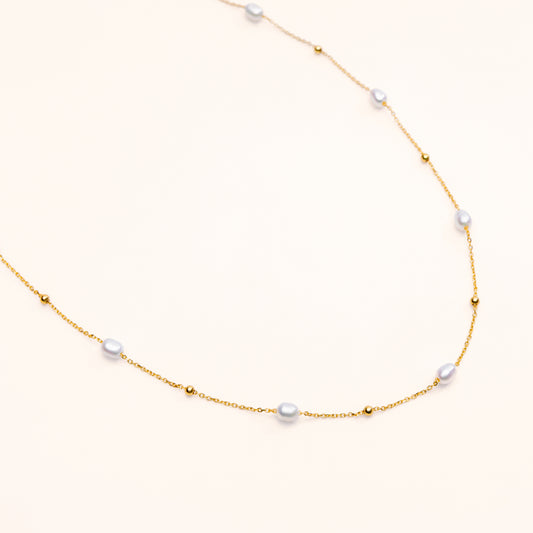
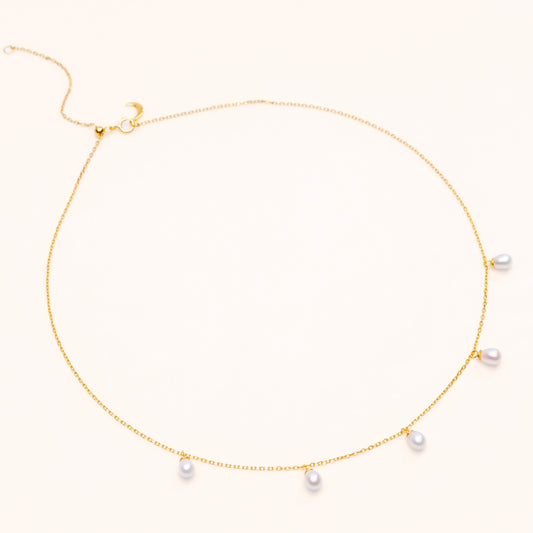
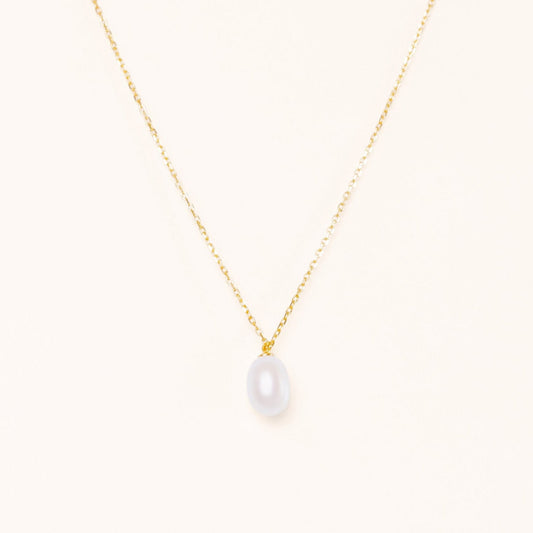
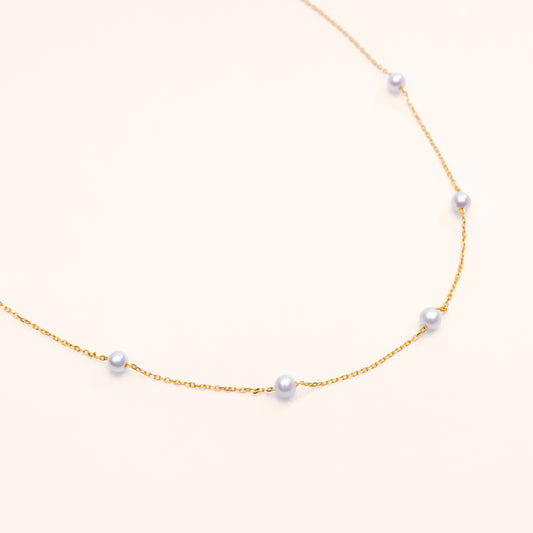
Before you resort to rubbing beads together, read the product description. A seller working with real material says so plainly — the pearl type, the metal, the plating. Our own pieces are made with real freshwater pearls set in 925 sterling silver, finished in 18k gold plating, and never brass, which is also why they're hypoallergenic and nickel-free. That's the product of 70 years working with pearls in Kobe, Japan, and it's stated on every listing rather than left for you to figure out.
Vagueness is the warning sign. "Pearl-effect," "pearlescent," "shell pearl," or a description that names no metal at all are all telling you something. If you'd like to see what honest freshwater pearls look like at a fair price, browse our pearl jewelry, the pearl necklaces collection, or everything under $100 — and if the numbers surprise you, our guide to what real pearls actually cost explains why real doesn't have to mean expensive.
Frequently asked questions
Are cultured freshwater pearls real pearls?
Yes. Cultured freshwater pearls are grown inside living mollusks, which coat an implanted irritant in layers of real nacre. The only difference from a natural pearl is that a farmer started the process deliberately. Almost all pearls sold today are cultured, and they may legally be called pearls without qualification under US labeling rules.
Does the tooth test really work on pearls?
It does work — real pearls feel gritty against tooth enamel while imitations feel smooth — but it can scratch the nacre if you press hard. Rubbing two pearls gently against each other gives you the same gritty-versus-glassy answer with no risk to the pearl, and is more practical when testing jewelry in a store.
How can you spot a fake pearl in a photo?
Look for uniformity and flat shine. Imitation pearls in photos are usually identical in size and shape, spotless, and reflect light as a hard white highlight sitting on the surface. Real pearls show slight variations in shape and tone, faint surface marks, and a softer glow that appears to come from within.
Are freshwater pearls worth less than saltwater pearls?
Freshwater pearls generally cost less than Akoya or South Sea pearls, mainly because each freshwater mussel can produce many pearls at once while saltwater oysters typically produce one. That's a supply difference, not a realness difference. Well-selected freshwater pearls offer excellent luster and durability at a fraction of saltwater prices.
Can real pearls be perfectly round?
Yes, but perfectly round real pearls are uncommon and priced accordingly. If a strand is flawlessly spherical, entirely blemish-free, perfectly matched, and inexpensive, imitation is the likeliest explanation. Genuine round pearls at a low price point almost always show subtle variation in shape or surface when examined closely in good light.