
Necklace Chain Types Explained: Cable, Box, Rope, and Which One to Buy
A necklace chain does three jobs: it carries weight, it drapes, and it survives being pulled over your head, caught on a scarf, and dropped into the bottom of a bag. The type of chain decides how it drapes and how it eventually fails. The thickness of the chain decides how strong it is. Most people shop the pendant and simply inherit whatever chain comes with it — which is how a beautiful piece ends up in a drawer with a permanent kink in it.
Here is how the common chain types actually differ, which ones hold a pendant properly, and what to look for before you buy.
The necklace chain types worth knowing
Cable chain
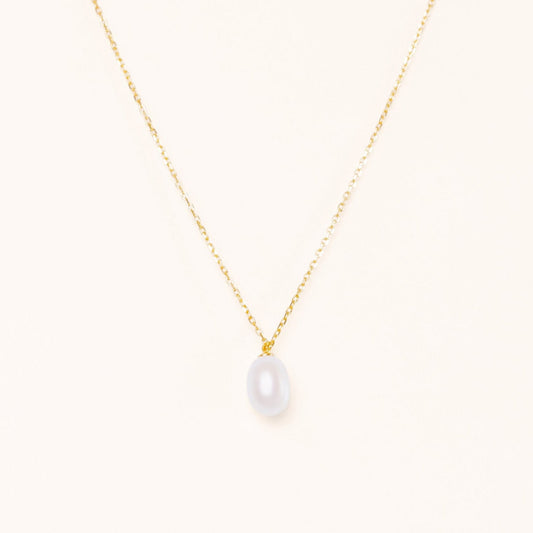
A cable chain is the default and the safest choice: identical oval or round links joined at right angles to each other. It is the most versatile chain type, the easiest for a jeweller to repair, and the least likely to kink permanently. It sits quietly under a shirt collar, carries a pendant without fuss, and still reads as jewellery on its own. Almost every fine pearl pendant you have admired was hanging on some version of a cable chain.
Box chain
A box chain is built from square links that lock together into a smooth, squared-off rope. For its width it is one of the strongest chain types, and its slight rigidity is an advantage with pendants: it resists twisting, so the pendant stays facing forward instead of spinning to the back of your neck. The trade-off is that a hard crimp — a bag strap, a car door — can flatten one link permanently.
Rope chain
Rope chains are made of small links twisted into a spiral, which catches light from every angle. They are strong for their weight and they drape beautifully. Two things to know: they use more metal per inch, so they cost more than a cable chain of the same length, and their sparkle competes with a pendant. A rope chain is usually happiest worn alone.
Curb and Figaro chains
Curb chains are twisted links flattened so they lie flush against the skin; Figaro chains are curb chains with a repeating long-short-short rhythm. Both are visually assertive and both lie very flat, which makes them good under knitwear. They are better as the statement than as the support act — a delicate pearl pendant tends to disappear on one.
Snake and herringbone chains
These are the liquid-looking chains: tightly fitted plates that form a smooth, unbroken surface. They photograph beautifully and they are the most fragile chains you can own, in one specific way. They kink. Bend a herringbone chain sharply once and the crease is permanent and effectively unrepairable. Do not hang a heavy pendant on one, and never sleep in one.
Beaded and station chains
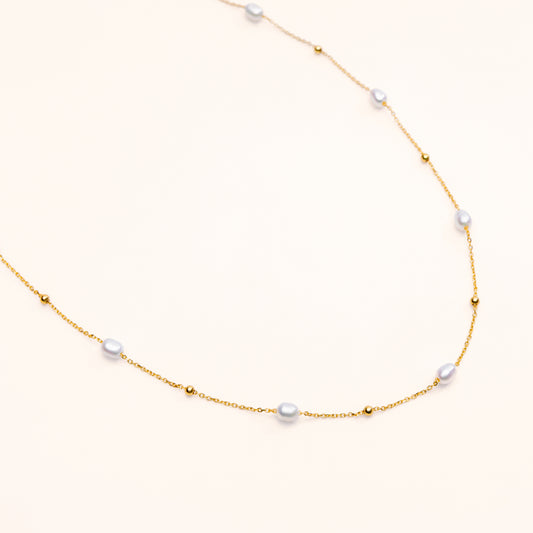
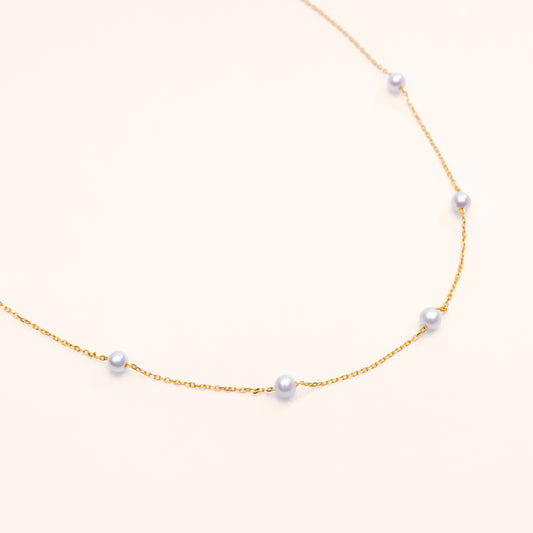
A station chain sets pearls or beads at intervals along a fine chain, so the chain itself becomes the design. These are not really pendant carriers — they are finished necklaces, and they layer well precisely because they add texture that a plain chain cannot. You can see the difference across our pearl necklaces, where station and pendant styles sit side by side.
Which necklace chain is strongest?
For the same metal and the same thickness, box and rope chains are the strongest, cable chain is close behind, and snake and herringbone chains are the most vulnerable. But chain gauge matters more than chain type: a 1.5 mm cable chain will outlast a 0.8 mm box chain every time. If durability is your priority, go one step thicker before you change style.
The other variable nobody mentions is the quality of the solder at each link. A well-made chain has every link fully closed and soldered. This is the difference you feel when you pick up a chain: a good one has a liquid, even weight and no gritty catch when you run it through your fingers.
Which chain holds a pendant best?
Cable and box chains hold a pendant best, because their links sit in a consistent plane. The pendant bail can slide freely and the pendant re-centres itself every time you move, instead of creeping toward one shoulder. Snake, herringbone, and heavily textured chains all fight the bail.
For weight, a simple rule works: the chain should look at least as substantial as the pendant is heavy. A 7–7.5 mm freshwater pearl pendant is well served by a fine chain in the 1–1.2 mm range — thin enough to keep the pearl the subject, strong enough to carry it for years. Go finer than that and the chain starts to look like an afterthought.

What chain to layer with
Layer textures, not just lengths. Two fine cable chains at different lengths read as one hesitant necklace; a plain cable chain paired with a pearl station chain reads as a deliberate look. Keep one piece plain so the eye has somewhere to rest, and give each layer at least two inches of clear space. We covered the maths in the necklace layering spacing formula, and the lengths themselves in our pearl necklace length guide.
The clasp matters as much as the chain
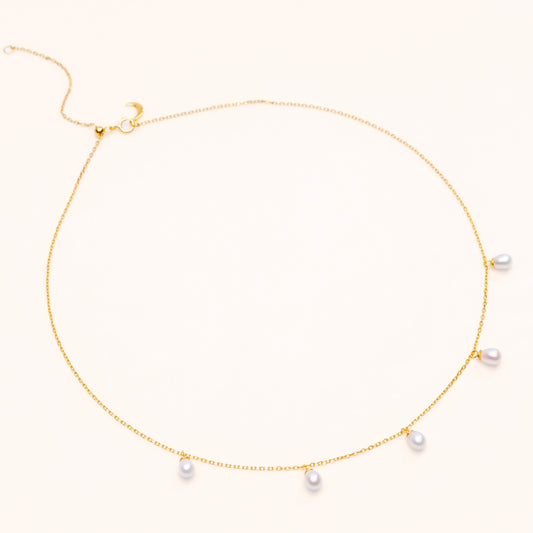
Most chains fail at the clasp, not in the middle. A spring ring clasp is light and discreet but has a small spring that wears out; a lobster clasp is more secure and easier to work one-handed. A sliding clasp is different again: the chain passes through an adjustable bead, so there is no single load-bearing catch to fail and the length is continuously adjustable.
Every Pearl Luna necklace uses an adjustable sliding clasp, which means one chain gives you a choker, a collarbone length, and everything between — useful when you are dressing for a high neckline one day and an open collar the next.
How to stop a chain kinking or breaking
Autumn is the season chains die. Knit sweaters, scarves, and coat collars all catch fine links, and the failure usually happens during dressing, not wearing. Four habits prevent nearly all of it: put your necklace on last and take it off first; open the clasp instead of pulling the chain over your head; store chains hanging or laid flat rather than coiled in a pouch; and take fine chains off before you sleep. Our guide to storing jewellery so it doesn't tangle or tarnish covers the rest.
What Pearl Luna chains are made of
Every chain we make starts as 925 sterling silver, finished in silver or plated in 18k gold — never brass, never plated steel. That matters for two reasons: sterling is hypoallergenic and nickel-free, so it does not react with skin the way base-metal chains do, and a sterling core means a chain that can be repaired and replated rather than replaced. Our plating descriptions follow US FTC standards, so what is written on the page is what is on the chain. Shipping is free, and returns are open for 30 days. You can see the full range across necklaces and jewellery under $100.
Frequently asked questions
What is the strongest necklace chain for everyday wear?
Box and rope chains are the strongest common types, with cable chain close behind. However, thickness matters more than style: a thicker cable chain outperforms a thinner box chain. For daily wear, choose a chain of at least 1 mm in a solid sterling silver or sterling-cored plated construction, and avoid herringbone.
What chain type is best for a pendant?
Cable and box chains are best for pendants. Their links sit in a single plane, so the bail slides freely and the pendant re-centres itself as you move rather than drifting sideways. Snake, herringbone, and heavily textured chains resist the bail and cause the pendant to sit crooked or twist backwards.
Can a kinked snake or herringbone chain be repaired?
Usually not. Snake and herringbone chains are made of interlocking plates, and once a crease deforms those plates the chain has lost its structure permanently. A jeweller can sometimes ease a very light bend, but a sharp kink is terminal. This is why these styles are best kept for occasional evening wear.
What chain thickness should I choose for a pearl pendant?
For a 7–8 mm freshwater pearl, a chain between 1 mm and 1.2 mm is the sweet spot. It is fine enough that the pearl stays the focal point, but substantial enough to carry the weight without stretching. For pearls above 10 mm, or for pendants with gemstone accents, step up to roughly 1.5 mm.
Does a gold-plated chain wear out faster than solid gold?
Plating does wear over time, and it wears fastest where the chain rubs against skin and clothing. An 18k gold plating over a sterling silver core lasts considerably longer than plating over brass, and because the base metal is precious, a worn chain can be cleaned and replated rather than discarded. Keeping it away from perfume and lotion extends the finish significantly.